


In the context of growing requirements for energy efficiency, ESG standards and decarbonization, the geothermal energy has established itself as a reliable and sustainable solution for heating, cooling and domestic hot water supply in a wide range of buildings and facilities in the domestic and tertiary sectors, and in the industrial and public sectors. The integration of geothermal installations with smart management systems allows for significant reduction of energy costs, access to renewable energy and carbon footprint reduction. The technology is applicable for:
- Commercial buildings and business centers, logistic and industrial zones
- Industrial premises and warehouses
- Hotels and SPA complexes
- Data centers, sports facilities, airports, greenhouses
- Residential complexes and public buildings (schools, kindergartens, hospitals, administrative buildings)
In order to ensure the efficient and successful implementation of a HVAC project with green geothermal energy, it is necessary to strictly follow consecutive steps – from a preliminary study to commissioning and maintenance.
Main phases in undertaking a HVAC project with the use of geothermal energy
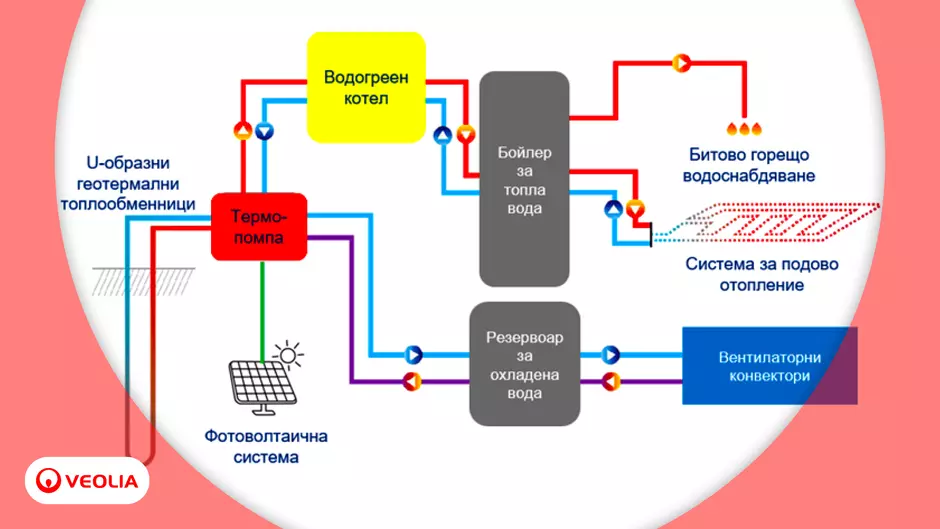
1. Consultation and Preliminary Analysis
The process starts with a consultation, where the main characteristics of geothermal energy and its use for heating and cooling are presented. A preliminary study is carried out to assess:
- Potential energy savings and payback period of the investment
- Saved and avoided carbon emissions
- Estimated operating costs
- Comparison between conventional and alternative solutions
- Model hydraulic system of the installation
- Opportunities for external and public financing
2. Testing Ground Thermal Conductivity (Thermal Response Test)
The test is an important scientific method for determining the thermal conductivity between the earth’s layers and a U-tube heat exchanger (probe). This is a critical phase for accurate specification of the number and the depth of probes, as well as for optimization of the geothermal installation. Through the knowledge of soil thermal dynamics, it is possible to prevent thermal imbalances, which may have an effect on the costs for installing a geothermal system and its long-term performance.
3. System Design
A technical project of the entire HVAC installation is prepared, including the construction of:
- Geothermal probes and tube heat exchangers
- Manifold system and pump room
- Machine room with earth-water heat pumps, circulation pumps, buffer tanks, supply and return manifolds, safety, control and regulating valves
- Building’s system for heating, cooling and domestic hot water: fan coil units, radiant floor heating and cooling systems, low-temperature radiators
- Electrical installation and control system (incl. BMS – Building Management System)
4. Coordination and Issuance of Permits
The complete documentation is prepared for obtaining the permits required for a HVAC project. The design parts are agreed with all competent authorities – municipalities, Regional Inspectorates of Environment and Water, Construction Supervision Bodies, Basin Directorates, Fire Safety Services, power distribution companies, etc. A construction permit is issued.
5. Equipment Delivery
After the design approval, delivery is conducted of:
- Earth-water heat pumps, chillers, buffer tanks
- Pipelines, expansion tanks, circulation pumps and valves
- Spare hot water boilers, BMS components, instrumentation and automation
- Fan coil units and a radiant floor heating and cooling system
6. Drilling and installation of a geothermal system
Drilling activities, installation of tube heat exchangers and construction of a manifold system are carried out. A pump room and pipe connections to the internal installation are completed.
7. Internal HVAC system installation
All elements of the internal heating and cooling system are installed in accordance with the design – fan coil units, radiant panels, floor heating and cooling systems, etc.
8. Building a machine room
Heat pumps, buffer tanks, circulation pumps, expansion tanks, control panels, BMS and automation tools are installed. The machine room ensures full control of the energy flows in the system.
9. Implementation of a control system (BMS)
The Building Management System offers centralized operation, automation and monitoring of all HVAC components, incl. for joint operation with a photovoltaic system. That provides high energy efficiency, climatic comfort, easy maintenance and adaptation to the operational conditions.
10. Start, settings and tests
The whole system is started and functional tests, hydraulic adjustments and fine tuning of parameters are performed. The operation in different modes is tested – heating, cooling and in transition seasons.
11. Commissioning
After the completion of all technical tests and checks in terms of legal requirements, the system is officially commissioned and is handed over to the Contracting Authority with the relevant documentation.
12. Staff Training
The technical and operational staff of the customer undergoes training for system operation, its maintenance, adjustments and the use of the control system. Instructions, technological and electrical circuit diagrams, timetables and service contacts are provided.
13. Maintenance and Warranty Service
It includes periodic technical maintenance, delivery of spare parts and consumables, emergency service and warranty maintenance of all main components of the system.
Opportunities for Your Project
The investment in geothermal heating and cooling is not simply choosing sustainable and green energy – it is a strategic solution for long-term efficiency and low maintenance costs. The capital expenditure made allows you the opportunity to certify your buildings under the nZEB standard (Nearly Zero-Energy Buildings). Whether you are developing a residential complex, commercial building, industrial site or a tourist accommodation property, an appropriately designed geothermal installation could significantly optimize energy and operational costs and increase the asset value.
How to start?
If you consider implementing a HVAC project with geothermal energy or want a preliminary assessment of your site, the Veolia Bulgaria team is there to assist you at every stage – from the preliminary study to the maintenance following the commissioning.
Contact us for:
- Individual consultation
- Technical and economic feasibility study
- Preliminary analysis of financing options
- Presentation for investors or designers
📧 [email protected]
📞 02 813 20 21